Voodoo Festival Benin Republic 2027

Dates, Rituals & How to Attend

The world’s most extraordinary spiritual gathering — where the ancient religion of Vodoun meets the living diaspora, and the drums of Ouidah echo across the Atlantic.

To witness the Fête du Vodoun is to understand that Voodoo was never the grotesque caricature Hollywood invented. It is a sophisticated, compassionate, and profoundly beautiful tradition — one that survived the Middle Passage to become the spiritual foundation of millions of people across the Americas, the Caribbean, and West Africa.

What Is the Fête du Vodoun?

The Fête du Vodoun — known internationally as the Voodoo Festival — is an annual national celebration held in Benin Republic every January 10th, a date that has been a public holiday since 1996. It is the world’s largest and most authentic gathering of Vodoun practitioners, scholars, diaspora returnees, and international visitors.

Vodoun (or Voodoo) is not the invented religion of horror films. It is one of humanity’s oldest continuous spiritual traditions — a complex cosmology in which the divine is present in all of nature, ancestors are active forces in daily life, and specially trained priests and priestesses serve as intermediaries between the human and spirit worlds. Vodoun was born along the Slave Coast of West Africa — the region that is now Benin, Togo, and parts of Nigeria — and it was carried across the Atlantic by the enslaved people of these coasts.

The Fête du Vodoun was formally established in 1993 under President Nicéphore Soglo, who declared Voodoo an official national religion after decades of suppression under Marxist rule. What began as a local celebration has grown into an international event drawing Vodou practitioners from Haiti, Candomblé followers from Brazil, Santería devotees from Cuba, and spiritual pilgrims from across the African diaspora and the wider world.

🌍 The Scale: The 2024 Fête du Vodoun drew an estimated 40,000+ visitors to Ouidah, including large delegations from Haiti, Brazil, Cuba, the United States, France, and the United Kingdom. The festival has been featured in the New York Times, BBC, Le Monde, and National Geographic.

Festival Schedule — What Happens When

Jan 9Arrival of Pilgrims & Opening Ceremonies

Vodoun communities and diaspora delegations arrive in Ouidah from across Benin and the world. Evening drumming and libation ceremonies begin in temple compounds across the city. The atmosphere is electric — a sense of expectation as the spiritual preparations intensify. Public gathering spaces fill with music and informal celebrations. Excellent evening to walk the town and absorb the energy.

Jan 10National Holiday — Grand Procession & Main Ceremonies

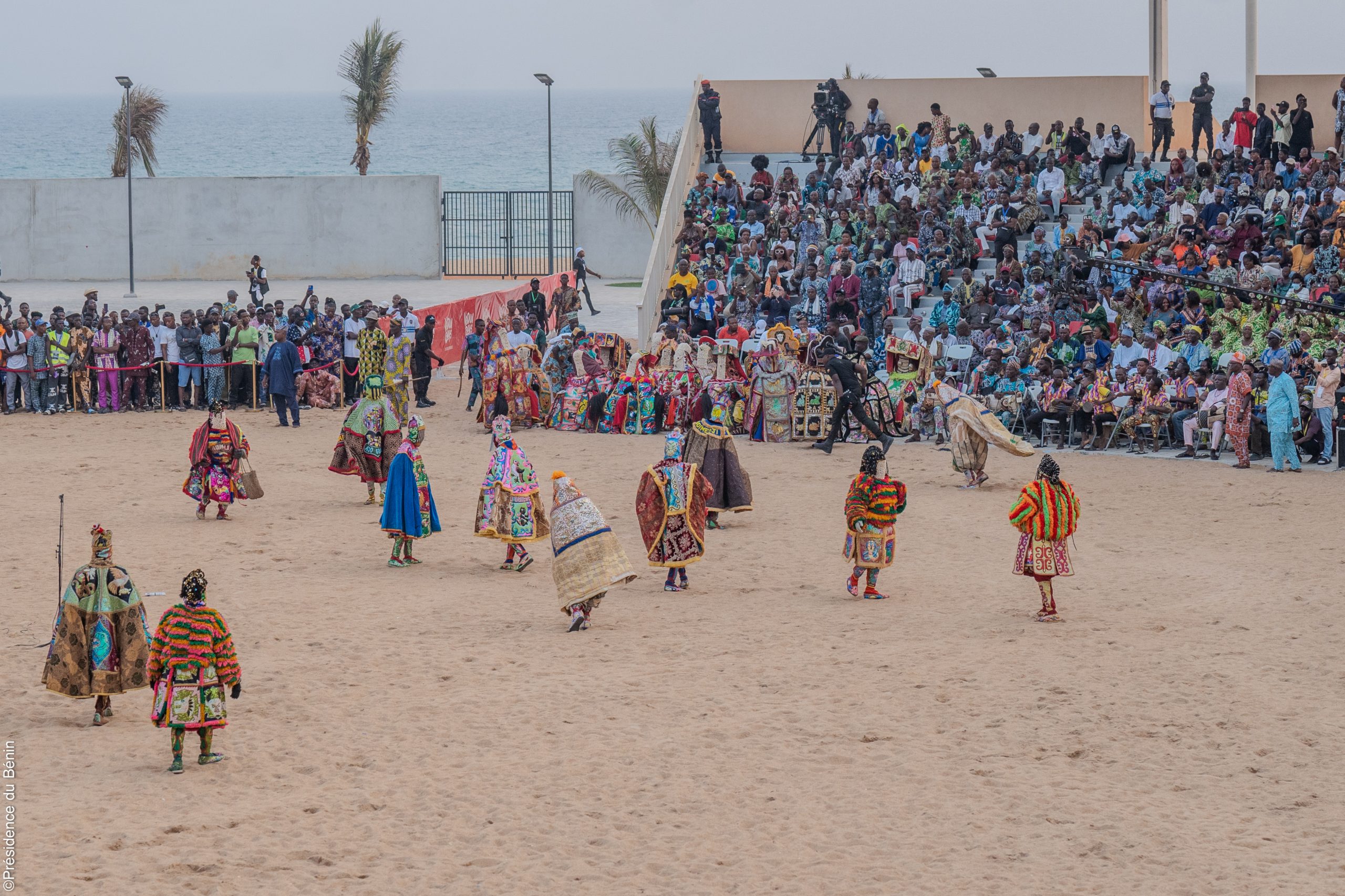
The centrepiece of the festival. Beginning at dawn, Vodoun priests and initiates in ceremonial dress process through Ouidah’s streets from the main square to the beach. Hundreds of Vodoun divinities (Vodun) are represented by costumed devotees. Rhythmic drumming, singing, and trance states are common. The procession reaches Ouidah beach at the Door of No Return for the central ceremony — a powerful act of spiritual commemoration involving prayers, offerings, and libations to the ocean and to ancestral spirits. The beach ceremony is open to all respectful visitors.

Jan 11Temple Ceremonies, Dance & Cultural Performances

The day after the main holiday features more intimate ceremonies in individual Vodoun temples (convents) across Ouidah and the surrounding region. Each temple’s community conducts rituals specific to their patron deity. Public cultural performances — traditional dance troupes, drumming competitions, and theatre — continue throughout the day. Evening brings live music to the Place Chacha (central square) and the beach promenades.

Jan 12Diaspora Day & Closing Ceremonies

The final day has an increasingly international character, with diaspora delegations from Haiti, Brazil, Cuba, and the United States participating in ceremonies that explicitly connect the diasporic traditions to their Beninese origins. The day concludes with a closing ceremony and libation at the Door of No Return, after which pilgrims begin their return journeys. An emotional and extraordinary day for anyone of African heritage attending.

Understanding What You Will Witness

For visitors unfamiliar with Vodoun, the festival can initially seem overwhelming — a flood of colour, sound, trance, and symbolism. Here’s a guide to the major ceremony types you may encounter:

Drum Ceremonies (Bata)

Each Vodun (deity) has specific rhythmic patterns on the bata drums that serve as a direct form of communication. The drumming calls the deity into presence, guides the ceremony, and facilitates the trance states of initiates. The rhythms are ancient and sacred — many identical to those heard in Candomblé and Haitian Vodou.

✅ OPEN TO OBSERVATION

Trance & Spirit Possession

A central element of Vodoun practice — an initiated devotee (called a zangbeto or vodunsi) may enter a trance state in which they are understood to be “ridden” by the deity. This is not a performance — it is a deeply serious spiritual experience. Initiates in trance may exhibit extraordinary physical behaviours. Observe with respect; do not interfere.

⚠️ OBSERVE FROM DISTANCE

Libation Ceremonies

Offerings of water, gin, palm oil, corn, and other items are poured on the ground, into the sea, or at shrines to honour the deities and the ancestors. The Door of No Return ceremony on January 10th culminates in a powerful collective libation at the ocean — a spiritual dialogue with the 12 million+ enslaved Africans who crossed these waters.

✅ OPEN TO PARTICIPATION

Zangbeto (Night Watchmen)

The mysterious Zangbeto — towering haystacks of woven straw that spin, dance, and move seemingly of their own accord — are the traditional guardians of communities and the Vodoun equivalent of police. Their appearance at festivals is a highlight, and their movements remain genuinely unexplained to outside observers.

✅ PUBLIC FESTIVAL APPEARANCES

Egungun (Ancestor Masquerade)

The Egungun masquerade — dazzlingly costumed figures representing the spirits of ancestors who return to visit the living — appear in processions, dance, and speak in altered voices. A profoundly important Yoruba and Fon tradition, with direct equivalents in Brazil and Cuba. When Egungun approach, make way respectfully.

✅ OPEN — RESPECTFUL DISTANCE

Sacrifice & Offerings

Animal sacrifice is an important part of Vodoun ritual — a gift to the deity that is understood as a profound act of reciprocity. Chickens, goats, and other animals may be sacrificed in temple ceremonies. This is a living sacred tradition. If you find it difficult to witness, it is entirely acceptable to move to a different part of the festival.

⚠️ INNER CEREMONIES ONLY

Meet the Vodoun Deities Who You'll Encounter

During the festival, each deity (Vodun) is represented by devotees in specific colours, costumes, and movements. Here are the most prominent you’ll encounter:

🐍 Dan (Ayida-Weddo) — The Rainbow Serpent

The supreme deity of Ouidah — the cosmic serpent who embodies continuity, the rainbow, and the connective force of the universe. Represented by the sacred pythons of the Python Temple. In Haiti: Damballa. In Brazil: Oxumarê.

⚡ Shango (Heviosso) — Lord of Thunder

God of thunder, lightning, and justice. Dancers in red and white represent Shango, known for his fierce energy and his role as dispenser of divine justice. In Cuba: Changó. In Brazil: Xangô.

🌊 Mami Wata — Spirit of the Waters

The powerful water spirit — depicted as a beautiful woman emerging from the sea — governs wealth, healing, beauty, and the ocean. Her devotees wear blue and white and are often seen near the beach during festival ceremonies.

🔱 Legba — Guardian of the Crossroads

The trickster guardian of all pathways, thresholds, and communication between worlds. The first deity invoked in any Vodoun ceremony. In Haiti: Papa Legba. In Cuba: Elegguá. Always depicted at crossroads and doorways.

⚔️ Gu — God of Iron and War

The deity of iron, tools, weapons, and labour. Gu governs technology and the forge. Represented in elaborate costumes of iron, chains, and blades. In Cuba: Ogún. In Brazil: Ogum. Celebrated for power and craftsmanship.

The Festival as Diaspora Homecoming

For the millions of people of African descent in Haiti, Brazil, Cuba, Trinidad, New Orleans, and beyond whose spiritual lives are shaped by Vodou, Candomblé, or Santería — attending the Fête du Vodoun in Ouidah is a journey of extraordinary emotional and spiritual significance.

These traditions are not imitations of Vodoun. They are Vodoun — transformed by 400 years of survival under slavery and colonialism, but fundamentally connected to the same deities, rhythms, cosmological frameworks, and modes of relationship with the divine that originated on this very coast. When a Haitian practitioner hears the Fon rhythms played in Ouidah, or a Brazilian Candomblé devotee recognises the altar of Oxumarê in the Python Temple of Dan — the recognition is cellular, not intellectual.

Visit Benin Republic designs dedicated Heritage & Roots packages for diaspora travellers — combining the Fête du Vodoun with ancestral region research, meetings with Vodoun communities, and cultural immersion experiences that make this far more than a festival visit. It is a return.

Practical Guide to Attending the Festival

When to Book

Book flights and accommodation at least 3–4 months ahead (by September/October). Ouidah and Cotonou hotels fill completely. January flights into Cotonou COO fill fast from European hubs.

Where to Stay

Cotonou offers the most accommodation options and is 45 min from Ouidah. Ouidah town has limited but atmospheric options (Casa del Papa, Auberge de Ouidah). Book direct with operators to secure rooms.

Getting Around

Private car hire recommended for festival days — roads around Ouidah fill with visitors. VBR can arrange dedicated festival transport from Cotonou including early-morning departure to catch the dawn procession.

What to Wear

White clothing is traditional and deeply respectful at Vodoun ceremonies. Cover shoulders and knees. Comfortable walking shoes for long standing and beach walking. Light layer for cool January evenings (18–24°C).

Photography

Generally welcomed at public processions and beach ceremonies. Always ask permission before photographing individuals, especially those in trance or performing ritual. Never photograph without consent in temple spaces.

Language

The festival is conducted in Fon, Yoruba, and French. A bilingual guide dramatically enhances the experience. VBR provides licensed cultural guides who can contextualise everything you witness in real time.

Frequently Asked Questions

When is the Voodoo Festival in Benin Republic?

The Fête du Vodoun is held annually on January 10th, a national public holiday. Main festivities span January 9–12, centred in Ouidah with events also in Cotonou, Porto-Novo, and Abomey.

Is the Voodoo Festival open to tourists?

Yes — the festival actively welcomes international visitors and diaspora returnees. Public ceremonies on the beach and main square are open to all. Some inner rituals within temple compounds are restricted to initiated practitioners.

How do I book accommodation for the Voodoo Festival?

Book at least 3–4 months in advance — October at the latest. Hotels fill completely. Visit Benin Republic can arrange accommodation and festival packages as part of our Heritage Tours.

Is Voodoo dangerous or scary for tourists?

No. Vodoun is a sophisticated, compassionate spiritual tradition — nothing like the Hollywood invention. Practitioners are warm and welcoming to respectful visitors. The festival is joyful, musical, and deeply moving.

What should I wear to the Voodoo Festival?

White clothing is traditional and deeply respectful. Cover shoulders and knees near sacred spaces. Comfortable walking shoes are essential. Bring a light layer for cool January evenings (18–24°C).

Leave a Reply

Why Book With Us?

  • No-hassle best price guarantee
  • Customer care available 24/7
  • Hand-picked Tours & Activities
  • We put you first

Get a Question?

Do not hesitage to give us a call. We are an expert team and we are happy to talk to you.

+229 01 56407067

[email protected]

Advertise with us

Do not hesitage to give us a call. We are an expert team and we are happy to talk to you.

+358408091764

[email protected]

Advertise with us

Do not hesitage to give us a call. We are an expert team and we are happy to talk to you.

+358 408091764

[email protected]

Advertise with us

Do not hesitage to give us a call. We are an expert team and we are happy to talk to you.

+358 408091764

[email protected]

Advertise with us

Do not hesitage to give us a call. We are an expert team and we are happy to talk to you.

+358 408091764

[email protected]

We are using cookies to give you the best experience. You can find out more about which cookies we are using or switch them off in privacy settings.
AcceptPrivacy Settings

GDPR

    Proceed Booking